What if your gearbox is already failing-quietly-and your monitoring program is looking in the wrong place?
Oil analysis and vibration monitoring both promise early fault detection, but they “listen” to different failure signals. One reveals what is happening inside the lubricant and wear surfaces; the other exposes mechanical movement, imbalance, looseness, and gear mesh distress.
For gearbox longevity, the real question is not which method is better in isolation. It is which method detects the specific failure mode early enough to prevent downtime, secondary damage, and expensive rebuilds.
This comparison breaks down where oil analysis excels, where vibration monitoring leads, and how combining both creates a stronger predictive maintenance strategy for critical gearboxes.
Oil Analysis vs. Vibration Monitoring: What Each Method Reveals About Gearbox Health
Oil analysis and vibration monitoring look at gearbox health from different angles, so they should not be treated as interchangeable predictive maintenance tools. Oil analysis shows what is happening inside the lubricant and wear surfaces, while vibration monitoring shows how the gearbox is behaving mechanically under load.
Oil analysis is strongest at detecting contamination, lubricant degradation, abnormal wear metals, moisture ingress, and additive depletion. For example, if a plant gearbox near a washdown area shows rising water content and iron particles in a lab report from a service like ALS Tribology, the issue may be seal failure long before operators hear noise or feel heat.
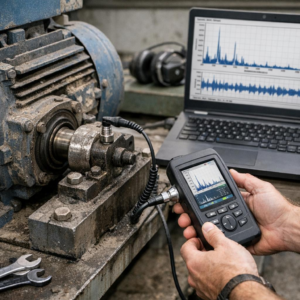
Vibration monitoring is better for identifying dynamic faults such as bearing defects, gear mesh problems, shaft misalignment, looseness, and imbalance. A wireless condition monitoring device such as SKF Enlight Collect or Fluke 3563 can trend vibration changes in real time, which is useful for critical gearboxes that run continuously and are expensive to shut down unexpectedly.
- Oil analysis reveals: lubricant condition, contamination, wear debris, and early surface damage.
- Vibration monitoring reveals: mechanical movement, impact, resonance, gear tooth damage, and bearing faults.
- Best use case: combine both methods for high-value gearboxes where downtime cost, repair cost, and safety risk are significant.
In practice, I’ve seen vibration alarms stay normal while oil analysis flagged rising silicon from dust entry, which later explained accelerated bearing wear. The opposite also happens: clean oil reports may look fine, but vibration data can expose a cracked gear tooth or loosened mounting before major failure.
How to Apply Oil Sampling and Vibration Data for Early Gearbox Fault Detection
For early gearbox fault detection, treat oil analysis and vibration monitoring as connected condition monitoring services, not separate reports. Oil sampling tells you what is wearing inside the gearbox, while vibration data shows how that wear is affecting load, alignment, bearings, and gear mesh behavior.
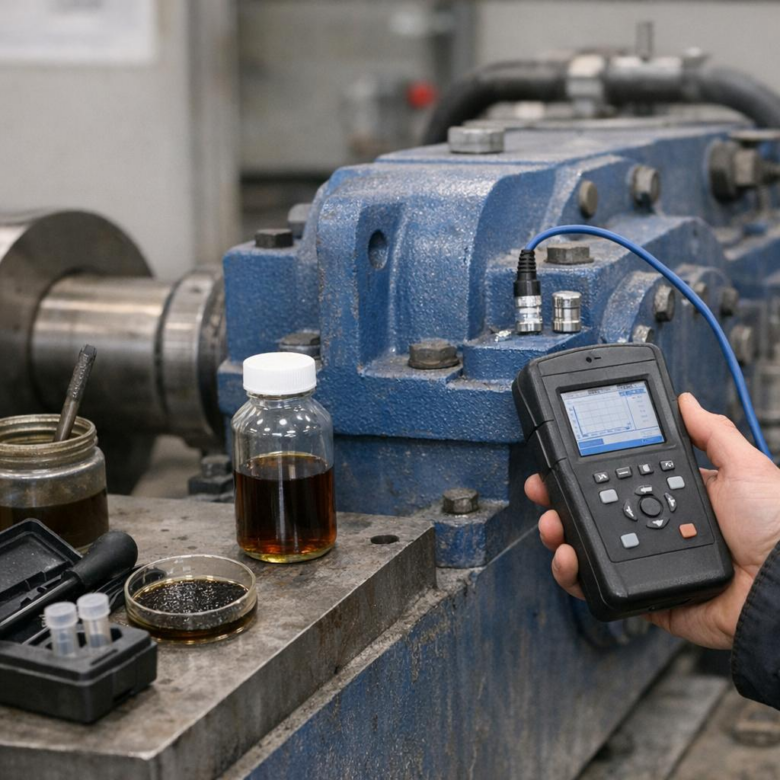
A practical approach is to sample gearbox oil on a fixed schedule, then compare results against vibration trends from sensors or portable analyzers such as Emerson AMS Machinery Manager. Look for rising iron, copper, silicon, water contamination, viscosity change, or abnormal particle counts, then check whether vibration shows gear mesh frequency changes, bearing defect frequencies, looseness, or misalignment.
- Oil first: rising wear metals may reveal early pitting before vibration alarms trigger.
- Vibration first: increased sidebands or bearing frequencies may point to mechanical stress even when oil looks acceptable.
- Both together: matching oil debris with vibration peaks gives stronger evidence before scheduling gearbox repair.
For example, in a conveyor drive gearbox, a lab report showing elevated iron and a particle count increase may seem minor. But if the vibration monitoring system also shows growing gear mesh sidebands, maintenance can plan an inspection during scheduled downtime instead of risking emergency gearbox replacement costs.
In the field, the biggest mistake is reacting to one bad reading without checking the trend. Use consistent oil sampling points, clean bottles, proper sample labels, and vibration routes taken at the same operating speed and load whenever possible. That discipline makes predictive maintenance software, reliability consulting, and industrial gearbox monitoring tools far more valuable.
When to Combine Oil Analysis and Vibration Monitoring for Maximum Gearbox Longevity
Combine oil analysis and vibration monitoring when gearbox failure would create expensive downtime, safety risk, or secondary damage to motors, shafts, and driven equipment. In practice, this means critical assets such as wind turbine gearboxes, conveyor drives, cooling tower gearboxes, mining crushers, and industrial reducers running 24/7 should rarely rely on one predictive maintenance method alone.
Oil analysis is excellent for spotting lubricant degradation, water ingress, contamination, and abnormal wear particles. Vibration monitoring is better at detecting misalignment, imbalance, bearing defects, gear mesh issues, and looseness while the gearbox is operating under load.
A good rule is to combine both when:
- The gearbox has a high replacement cost or long lead time for spare parts.
- Oil samples show rising iron, copper, silicon, or moisture levels but the machine still sounds normal.
- Vibration trends show increasing gear mesh frequency, sidebands, or bearing fault patterns before oil results confirm wear.
For example, I’ve seen a plant catch a developing bearing issue on a large conveyor gearbox because vibration data from Emerson AMS Machinery Manager showed a rising defect frequency, while the oil report later confirmed increased metallic wear. Acting on both signals allowed maintenance to schedule a planned shutdown instead of paying for emergency gearbox repair services and production loss.
The best setup is simple: use routine oil analysis monthly or quarterly, then pair it with continuous vibration sensors or route-based vibration data collection for critical equipment. This combined condition monitoring strategy improves fault diagnosis, supports better maintenance planning, and helps justify the cost of predictive maintenance tools with fewer surprises.
Wrapping Up: Comparing Oil Analysis vs. Vibration Monitoring for Gearbox Longevity Insights
Gearbox longevity is best protected by using oil analysis and vibration monitoring as complementary tools, not competing choices. Oil analysis gives early warning of wear, contamination, and lubrication breakdown; vibration monitoring confirms how mechanical faults are developing under load.
- Choose oil analysis when contamination control and lubricant health are the priority.
- Choose vibration monitoring when detecting misalignment, imbalance, looseness, or bearing damage is critical.
- Use both for high-value, high-risk, or hard-to-access gearboxes.
The practical decision is simple: match the method to the failure risk, then integrate both where downtime costs justify deeper visibility.