What if your bearing is already failing-but the machine still sounds perfectly healthy?
Vibration spectra often reveal damage long before heat, noise, or catastrophic breakdown appears. The challenge is knowing which peaks are meaningful, which are harmless, and which signal an early-stage defect.
By learning how to read frequency patterns, harmonics, sidebands, and bearing fault frequencies, maintenance teams can separate normal machine behavior from the first signs of spalling, looseness, lubrication failure, or misalignment.
This guide explains how to interpret vibration spectra with a practical focus on detecting early bearing failure-so you can act before a minor defect becomes an expensive shutdown.
What Bearing Defect Frequencies Reveal in a Vibration Spectrum
Bearing defect frequencies help you identify which part of the bearing is failing before the damage becomes obvious in the time waveform. In a vibration spectrum, these frequencies usually appear as peaks at calculated fault rates, often with harmonics and sidebands that show how advanced or loaded the defect may be.
The main frequencies to check are BPFO for outer race defects, BPFI for inner race defects, BSF for rolling element damage, and FTF for cage-related issues. A good vibration analysis software package, such as Emerson AMS Machinery Manager or SKF @ptitude Analyst, can calculate these values when you enter bearing geometry, shaft speed, and machine details.
- BPFO: Often produces stable peaks because the outer race is usually fixed in place.
- BPFI: Commonly shows sidebands around the defect frequency due to load zone modulation.
- BSF or FTF: Can be harder to confirm and may require envelope analysis or high-frequency acceleration data.
For example, on a plant motor driving a process pump, a peak at BPFO with matching harmonics may point to early outer race spalling, even if the bearing temperature and noise still seem normal. Catching this early allows maintenance teams to plan bearing replacement during scheduled downtime instead of paying the higher cost of emergency repair, shaft damage, or production loss.
One practical tip: do not judge a bearing fault from one peak alone. Compare the spectrum with historical trends, lubrication condition, load changes, and data from a portable vibration analyzer or wireless vibration sensor used in a predictive maintenance program.
How to Analyze FFT Vibration Spectra for Early Bearing Fault Detection
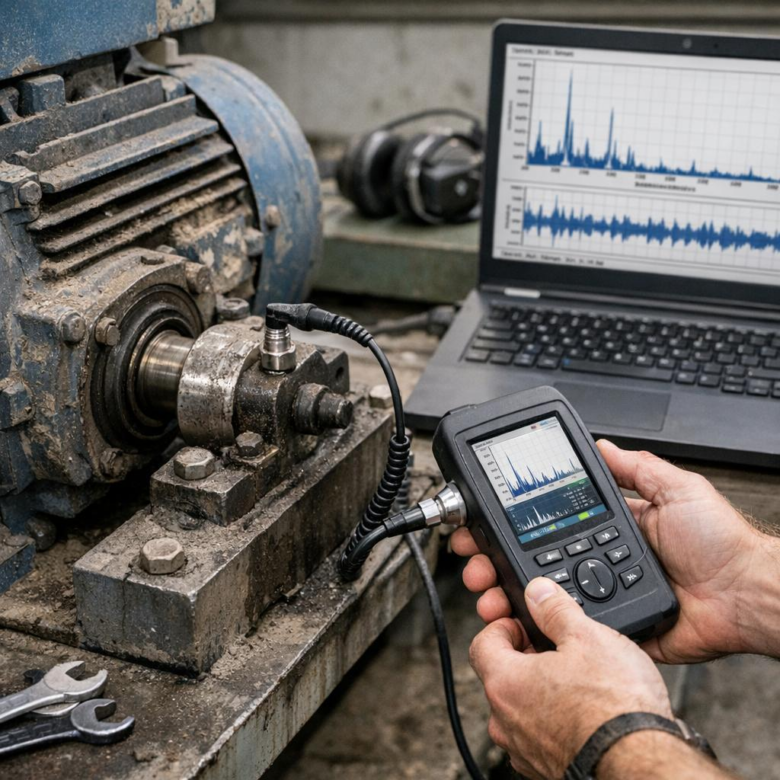
Start by comparing the FFT vibration spectrum against a known good baseline from the same machine, speed, load, and sensor location. Early bearing failure rarely appears as one obvious peak; it often shows as small increases at bearing defect frequencies with sidebands around running speed, especially when using a quality vibration analyzer such as Fluke 3563 Analysis Vibration Sensor or Emerson AMS Machine Works.
Focus on the bearing fault frequencies: BPFO, BPFI, BSF, and FTF. These depend on bearing geometry and shaft speed, so use the bearing number in your predictive maintenance software instead of guessing from generic charts. In the field, I often see outer race defects appear first as repeated BPFO harmonics, while lubrication problems usually raise broadband high-frequency energy before clear defect peaks develop.
- Check harmonics: Multiple peaks at 2x, 3x, or 4x a bearing fault frequency are more suspicious than a single isolated spike.
- Look for sidebands: Sidebands spaced at 1x RPM can indicate load modulation, looseness, or a progressing inner race defect.
- Use envelope analysis: Demodulation helps reveal weak bearing impacts hidden under normal machine vibration.
For example, on a motor-driven pump, a normal FFT may show dominant 1x RPM and vane-pass frequency. If a new set of small BPFO harmonics appears in the high-frequency range and the trend rises over several routes, that is a stronger early warning than one alarm event. This approach helps justify bearing inspection, lubrication service, or planned replacement before costly unplanned downtime.
Common Mistakes That Lead to Missed or Misdiagnosed Bearing Failure
One of the most common mistakes is relying only on overall vibration levels. Early bearing defects often appear as low-energy peaks in the high-frequency range or in the envelope spectrum, while the overall RMS value still looks acceptable. This is why condition monitoring programs using tools like SKF @ptitude Analyst or portable vibration analyzers should trend both broadband vibration and bearing-specific fault frequencies.
Another frequent error is using the wrong bearing geometry or running speed when calculating BPFO, BPFI, BSF, and FTF. A small speed mismatch can shift the expected fault frequency enough to make a real defect look like random noise. In one plant inspection, a suspected motor bearing issue was dismissed until the analyst corrected the actual VFD speed and found a clear outer race frequency with harmonics.
- Ignoring sensor placement: A poorly mounted accelerometer or wireless vibration sensor can miss impacts, especially on low-speed equipment.
- Confusing looseness with bearing damage: Mechanical looseness can create harmonics that resemble fault patterns, so phase analysis and inspection history matter.
- Skipping lubrication review: Poor lubrication can raise high-frequency noise before a visible defect forms, making oil analysis and vibration analysis more powerful together.
Misdiagnosis also happens when analysts look at one spectrum in isolation. Compare trends, load conditions, temperature, ultrasound readings, and maintenance records before recommending bearing replacement. This avoids unnecessary repair cost and makes predictive maintenance services far more reliable.
Key Takeaways & Next Steps
Early bearing failure is rarely confirmed by one spectral peak alone. The strongest decisions come from combining fault-frequency patterns, harmonics, sidebands, trend history, and operating context.
Practical takeaway: treat vibration spectra as an early-warning tool, not a pass/fail verdict. When bearing-related components rise consistently above baseline, especially with matching demodulation evidence or increasing sidebands, escalate from monitoring to action.
- Verify speed, load, and sensor quality before diagnosing.
- Trend changes over time rather than reacting to isolated readings.
- Plan inspection or replacement when spectral evidence aligns with rising severity.