How much profit is escaping through leaks you can’t even hear?
In compressed air systems, even a tiny leak can waste thousands in energy costs, reduce equipment performance, and force compressors to work harder than they should.
Ultrasound leak detection makes those hidden losses visible by identifying high-frequency leak sounds in noisy industrial environments with speed and precision.
This step-by-step guide shows how to prepare, inspect, pinpoint, document, and prioritize compressed air leaks using ultrasound technology.
What Ultrasound Leak Detection Reveals About Compressed Air System Losses
Ultrasound leak detection shows where compressed air is escaping, but its real value is showing how much waste is hidden in plain sight. In many industrial compressed air systems, leaks are not obvious because the plant is noisy, the piping is overhead, or the leak only occurs when pressure rises during production.
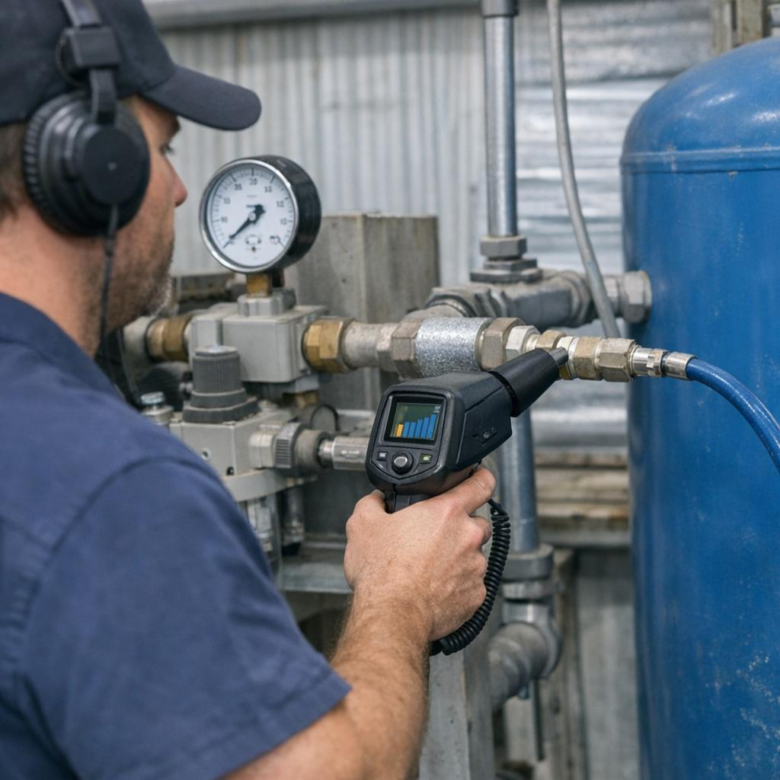
An ultrasonic leak detector converts high-frequency leak noise into an audible signal, helping technicians locate small leaks around fittings, quick couplers, hoses, valves, regulators, air cylinders, and drain traps. Tools such as the UE Systems Ultraprobe or SDT ultrasound detectors can also help rank leaks by severity, which is useful when planning compressed air maintenance or a plant energy audit.
In a real maintenance setting, a technician may scan a packaging line and find a leaking push-to-connect fitting behind a machine guard. The leak may sound minor, but if it runs all shift, every day, it adds demand to the air compressor, increases energy cost, and can reduce available pressure for critical equipment.
- Leak location: identifies the exact component causing air loss, not just the general area.
- Leak priority: helps decide which repairs deliver the best return on maintenance time.
- System behavior: reveals pressure drops, poor isolation, or leaks that appear only under load.
This information supports smarter decisions about compressor sizing, preventive maintenance, and professional leak detection services. Instead of guessing why the compressor runs constantly, ultrasound testing gives the maintenance team clear evidence to repair the right leaks first.
How to Perform a Step-by-Step Ultrasonic Leak Survey in Compressed Air Lines
Start the ultrasonic leak survey when the plant is operating under normal compressed air demand, because leaks are easier to identify under real pressure conditions. Use a quality ultrasonic leak detector such as the UE Systems Ultraprobe or SDT device, set the frequency around 38-40 kHz, and wear the recommended headphones to isolate leak sounds from production noise.
Walk the system in a planned route rather than randomly scanning. Begin at the compressor room, then follow headers, drops, filters, regulators, lubricators, quick couplers, hoses, valves, and pneumatic equipment. Keep the sensor aimed slowly around each fitting, and reduce sensitivity as the signal gets stronger so you can pinpoint the exact leak source.
- Tag each leak with location, asset number, and severity level.
- Record dB readings, pressure, and photos for repair planning.
- Prioritize leaks near end-use equipment, open blow-offs, and aging hose connections.
A real-world example: in a packaging area, a technician may hear a sharp “hiss” near a pneumatic cylinder manifold even though operators cannot hear anything over conveyors. After confirming it with the ultrasonic leak detector, maintenance may find a cracked push-to-connect fitting that costs little to replace but wastes compressed air every shift.
For best results, upload findings into maintenance software or a leak reporting platform and estimate repair cost versus energy savings. Many facilities treat compressed air leak detection as part of an industrial energy audit or predictive maintenance program, because documented leaks are easier to justify, schedule, and verify after repair.
How to Prioritize, Document, and Verify Compressed Air Leak Repairs for Maximum Savings
After an ultrasound survey, do not hand maintenance a random list of leaks. Rank each compressed air leak by estimated air loss, operating pressure, production impact, and repair difficulty so the highest-cost leaks are fixed first. A large leak on a main header running 24/7 usually deserves priority over a small fitting leak on an idle machine.
Use a simple scoring method inside a CMMS such as Fiix, UpKeep, or your plant’s maintenance management software. Attach the ultrasound image or audio file from a device like the Fluke ii900, then assign a work order with a clear repair action.
- Record: leak ID, location, asset number, pressure, ultrasonic reading, estimated CFM loss, and photo.
- Prioritize: annual energy cost, safety risk, accessibility, and required downtime.
- Verify: recheck the same point with the ultrasonic leak detector after repair.
A real-world example: in a food packaging area, a leaking push-to-connect fitting above a conveyor may look minor, but if that line runs every shift, the compressed air energy cost can exceed the price of the fitting many times over. Tagging it, photographing it, and linking it to a work order prevents it from disappearing into a spreadsheet nobody opens.
Verification is where savings become real. After repairs, rescan the leak point, update the status, and compare compressor load, pressure stability, or kWh trend data where available.
Summary of Recommendations
Ultrasound leak detection turns compressed air maintenance from guesswork into a measurable reliability practice. The real value comes from acting quickly: tag leaks, prioritize by estimated loss, repair the highest-impact points first, and verify results after the fix.
- Use it routinely: schedule surveys before energy costs rise or pressure problems appear.
- Prioritize wisely: focus on large leaks, critical production areas, and repeat failure points.
- Measure outcomes: track repaired leaks, saved air, and reduced compressor load.
A disciplined leak detection program pays for itself through lower energy use, better system stability, and longer equipment life.