What if your ventilation system is “working” but still putting your facility out of compliance?
In industrial environments, air quality failures rarely begin with obvious breakdowns. They often start as small compliance gaps: undocumented airflow changes, aging controls, poor capture at the source, or monitoring data no one is reviewing closely enough.
These gaps can expose workers to hazardous dust, fumes, vapors, and gases while increasing the risk of citations, shutdowns, production losses, and long-term liability.
Resolving them requires more than checking boxes. It demands a practical look at system design, regulatory expectations, exposure data, maintenance practices, and the real conditions employees face on the floor.
What Industrial Ventilation Compliance Gaps Are and Why They Threaten Air Quality, Worker Safety, and Regulatory Approval
Industrial ventilation compliance gaps are the differences between what a facility’s ventilation system is supposed to control and what it actually controls during daily production. These gaps often appear in exhaust airflow rates, capture velocity, duct design, filter maintenance, make-up air balance, or missing exposure monitoring records required for OSHA compliance, EPA air permitting, and indoor air quality audits.
In real facilities, the problem is rarely one dramatic failure. It is usually a pattern: a dust collector running below design capacity, welding fume extraction arms positioned too far from the source, or a spray booth filter changed “when it looks dirty” instead of on a documented preventive maintenance schedule.
- Undersized or poorly balanced local exhaust ventilation can leave airborne contaminants in the breathing zone.
- Missing inspection logs can delay regulatory approval even when equipment is installed.
- Clogged filters and worn fan belts increase energy cost while reducing air quality performance.
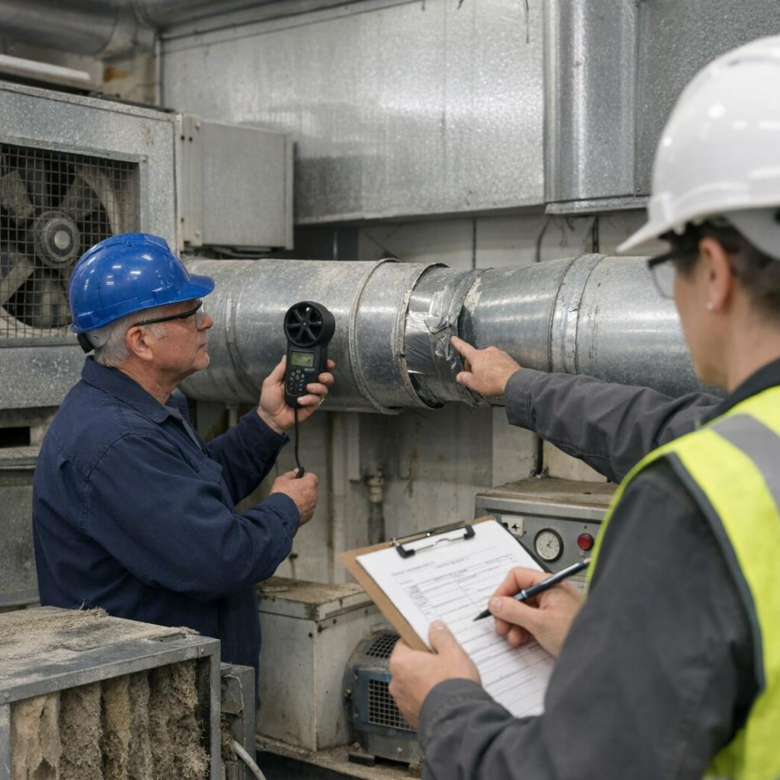
For example, a metal fabrication shop may have a high-quality fume extraction system, but if airflow testing shows weak capture at several welding stations, employees may still be exposed to hexavalent chromium or manganese fumes. In that case, the compliance fix may involve hood repositioning, duct balancing, replacement filters, and documented air monitoring using a device such as TSI VelociCalc for airflow measurement.
The risk is bigger than a failed inspection. Poor ventilation can trigger worker complaints, respiratory hazards, production shutdowns, higher insurance scrutiny, and expensive retrofit work that could have been avoided with routine industrial hygiene testing, ventilation system commissioning, and reliable maintenance documentation.
How to Audit Ventilation Systems for OSHA, NFPA, ASHRAE, and EPA Air Quality Requirements
Start the audit by mapping each ventilation system to the hazard it controls: welding fumes, solvent vapors, combustible dust, silica, paint overspray, or general indoor air quality. OSHA focuses on worker exposure limits, NFPA addresses fire and explosion risks, ASHRAE guides ventilation performance, and EPA requirements often apply to emissions, filtration, and hazardous air pollutants.
A practical audit should verify airflow, capture velocity, pressure balance, filter condition, duct integrity, and exhaust discharge locations. Use calibrated instruments such as a hot-wire anemometer, smoke tubes, manometer, and a direct-reading air monitor; platforms like TSI Link can help track IAQ monitoring data and identify recurring ventilation failures.
- Measure: Compare actual airflow and contaminant levels against design specs, OSHA PELs, and applicable ASHRAE ventilation rates.
- Inspect: Check hoods, dampers, dust collectors, make-up air units, spark arrestors, and explosion venting where NFPA standards apply.
- Document: Keep test reports, calibration records, maintenance logs, filter change history, and corrective action costs.
For example, in a metal fabrication shop, a weld fume extractor may appear functional but fail because operators position the hood too far from the arc. I’ve seen compliance improve faster by combining airflow testing with worker observation than by replacing expensive equipment first.
The audit should end with a prioritized action list: low-cost fixes like damper adjustment and filter replacement, followed by engineering upgrades such as local exhaust ventilation redesign, HEPA filtration, or automated air quality monitoring. This approach supports regulatory compliance while giving management a clear view of risk, budget, and operational benefits.
Common Industrial Air Quality Compliance Mistakes and How to Prevent Repeat Violations
One of the most common mistakes is treating industrial air quality compliance as a one-time inspection task instead of an ongoing operating requirement. Facilities often pass an initial ventilation audit, then fall out of compliance because filters, dust collectors, VOC sensors, and exhaust fans are not maintained on a fixed schedule. This is where preventive maintenance software like Fiix or a similar CMMS can help document service dates, repairs, calibration records, and corrective actions.
Another frequent issue is poor sensor placement. I’ve seen welding shops install air quality monitors too close to doors or supply air vents, which produced cleaner readings than workers were actually breathing near the source. For better OSHA compliance and indoor air quality testing accuracy, monitors should be placed near emission points, employee work zones, and return air paths-not just where installation is convenient.
- Missed calibration: Schedule calibration services for particulate monitors, VOC detectors, and gas sensors before readings become unreliable.
- Incomplete documentation: Keep inspection reports, filter change logs, SDS records, and EPA emissions reporting files in one accessible system.
- Delayed repairs: Treat damaged ductwork, clogged baghouse filters, and weak capture velocity as compliance risks, not routine maintenance problems.
Repeat violations usually happen when responsibility is unclear. Assign one owner for air quality compliance management, but require production, maintenance, and EHS teams to review findings together. A small monthly review of ventilation performance, monitoring data, and corrective actions can prevent expensive fines, shutdown risk, and avoidable worker exposure claims.
Key Takeaways & Next Steps
Closing compliance gaps requires treating ventilation and air quality as active risk controls, not one-time engineering checks. The strongest approach is to pair verified system performance with clear ownership, routine monitoring, and documented corrective action.
- Prioritize risks that affect worker exposure, regulatory limits, and production continuity.
- Use data from inspections, sampling, and airflow testing to guide investment.
- Act early when trends show declining capture efficiency, poor filtration, or recurring complaints.
The right decision is the one that protects people, proves compliance, and keeps operations resilient.