What if a single dusty lens could throw an entire piping system out of tolerance?
In industrial piping, laser alignment tools are only as reliable as the condition they’re kept in. Small maintenance oversights-contaminated optics, weak batteries, poor storage, or missed calibration-can translate into costly rework, vibration issues, flange stress, and shutdown delays.
Proper tool care is not just housekeeping; it is a precision-control practice. When lasers are cleaned, checked, calibrated, and stored correctly, crews can trust their readings and complete alignments faster with fewer disputes in the field.
This article outlines practical best practices for maintaining laser alignment tools so they remain accurate, durable, and ready for demanding industrial piping environments.
Why Laser Alignment Tool Maintenance Matters for Industrial Piping Accuracy and Safety
Laser alignment tools are only as reliable as their calibration, lens condition, battery health, and mounting stability. In industrial piping, even a small alignment error can lead to flange stress, premature gasket failure, pump vibration, or costly rework during installation and shutdown maintenance.
In the field, I’ve seen crews lose hours chasing a “pipe fit-up problem” that was actually caused by a dirty laser lens and a loose tripod mount. A quick inspection and recalibration of a device such as the FARO Laser Tracker or similar laser alignment system can prevent bad readings before they become expensive mechanical issues.
Proper maintenance directly supports piping accuracy, equipment reliability, and workplace safety. It also helps protect the investment in high-value industrial measurement tools, where repair cost, calibration services, and replacement devices can be significant.
- Clean optics improve measurement precision in dusty fabrication shops and outdoor job sites.
- Scheduled calibration supports compliance with project quality control and inspection requirements.
- Battery and cable checks reduce downtime during critical pipe alignment or machinery installation work.
Well-maintained laser alignment equipment gives supervisors more confidence when verifying pipe spools, rotating equipment connections, and structural supports. More importantly, it reduces the chance of forcing components into position, which can create hidden stress and safety risks that show up later as leaks, vibration, or unplanned maintenance.
How to Clean, Calibrate, Store, and Inspect Laser Alignment Tools in Piping Environments
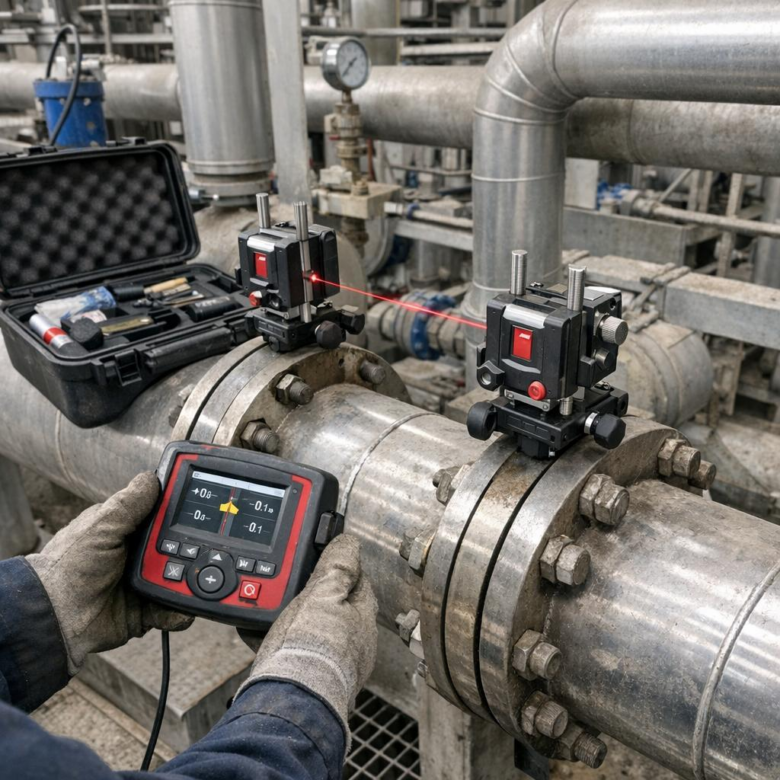
Laser alignment tools used around industrial piping pick up more than dust; they are exposed to oil mist, pipe scale, moisture, welding residue, and vibration. After each job, wipe the transmitter, receiver, brackets, chains, and magnetic bases with a lint-free cloth and a manufacturer-approved cleaner. Never spray solvent directly onto lenses or sensor windows, because residue can distort readings and increase alignment error.
Calibration should be treated as part of your preventive maintenance program, not an afterthought. For devices such as Easy-Laser XT, SKF TKSA, or Fluke 830, follow the recommended calibration interval and use certified calibration services when the tool has been dropped, exposed to heavy vibration, or used in high-heat piping areas. In my experience, a “slightly off” laser can waste hours during pump-to-pipe alignment because crews start correcting equipment that was never truly misaligned.
- Store alignment devices in a sealed hard case with foam inserts and silica gel packs to control moisture.
- Remove batteries before long storage to prevent leakage and expensive electronics damage.
- Keep calibration certificates, inspection logs, and repair records with the asset management file.
Before every use, inspect cables, mounting hardware, chain clamps, display screens, Bluetooth connections, and battery contacts. Check that magnetic bases sit flat and that brackets do not flex under normal tightening. A refinery maintenance team, for example, may get poor repeatability on a compressor alignment simply because pipe vibration loosened a clamp during setup. Small checks protect accuracy, reduce maintenance cost, and extend the service life of these precision alignment tools.
Common Maintenance Mistakes That Reduce Laser Alignment Precision and Tool Lifespan
One of the most common mistakes is treating laser alignment tools like ordinary hand tools. Precision measurement devices need clean lenses, protected sensor heads, and stable storage conditions; leaving a unit in a hot work truck or near grinding dust can affect readings long before visible damage appears.
Another issue is skipping scheduled calibration because the tool “still looks accurate.” In industrial piping, even a small alignment error can create flange stress, pump vibration, gasket leaks, and higher maintenance cost. For example, a crew aligning a pump discharge line with an unverified laser system may tighten the flange successfully, only to see premature seal failure after startup.
- Cleaning lenses with rough rags: use optical wipes or manufacturer-approved cleaning kits to avoid micro-scratches.
- Ignoring battery health: weak batteries can cause shutdowns, unstable readings, or lost measurement data during field alignment.
- Transporting without a case: vibration in service trucks can knock brackets, sensors, and laser heads out of tolerance.
Technicians using systems such as Easy-Laser or PRÜFTECHNIK ROTALIGN should also inspect mounting brackets, chains, magnets, and cables before each job. In real plant maintenance work, worn fixtures often cause more repeat measurements than the laser device itself.
A practical habit is to log each inspection, battery replacement, firmware update, and calibration service in the same preventive maintenance software used for pumps and compressors. This makes it easier to justify repair, replacement, or rental costs before tool failure delays a shutdown or turnaround schedule.
Key Takeaways & Next Steps
Reliable pipe alignment is not achieved at the moment of measurement; it is protected through disciplined care of the tool. Treat laser alignment equipment as a precision asset, not a jobsite accessory, and build maintenance into routine work planning.
Practical takeaway: if accuracy affects weld quality, fit-up time, or shutdown risk, choose tools with clear calibration support, durable protection, and traceable service records. Replace improvised handling with documented inspection, storage, and verification habits. The right decision is the one that keeps alignment data trustworthy when conditions are harsh and schedules are tight.