Are your resin cast car parts selling out-or silently underpriced?
For online collectors, price is more than a number; it signals rarity, craftsmanship, accuracy, and trust.
Custom resin parts sit in a tricky market where material cost is only the beginning. Mold life, cleanup time, failed casts, niche demand, licensing concerns, and collector expectations all shape what you can charge.
This guide shows how to price resin cast car parts so your work feels fair to buyers, protects your margins, and positions each piece as a collectible-not just a replacement part.
What Determines the Value of Custom Resin Cast Car Parts for Collectors
The value of custom resin cast car parts depends on more than material cost. Collectors pay for accuracy, rarity, fitment, finish quality, and whether the part solves a hard-to-find replacement problem for a specific scale model, slot car, diecast restoration, or RC car build.
Detail is usually the first thing buyers notice. A resin hood with clean panel lines, correct vents, and minimal sanding work will command a better price than a rough casting, even if both use the same silicone mold and polyurethane resin. In practice, a 1:24 scale resin bumper for an out-of-production Tamiya kit can sell better than a generic spoiler because it completes a model that collectors already invested in.
- Rarity: Parts for discontinued kits, vintage diecast cars, or limited-run models often justify higher pricing.
- Condition and prep: Bubble-free casting, sharp edges, and primer-ready surfaces reduce the buyer’s labor cost.
- Proof of fit: Photos showing the part test-fitted on the actual model increase buyer confidence and reduce returns.
Production method also matters. Parts designed in CAD, printed on a resin 3D printer, and finished with quality mold-making supplies may support a premium price because the final product is more consistent. Platforms like eBay are useful for checking completed sales, while hobby forums and Facebook collector groups reveal what people are actively searching for but cannot easily buy.
A practical pricing tip: separate “custom artwork” from “replacement utility.” A plain mirror set may be priced on cost and labor, but a screen-accurate movie car conversion kit can carry collector value because it creates a specific, desirable result.
How to Calculate Material, Labor, Mold, and Finishing Costs Accurately
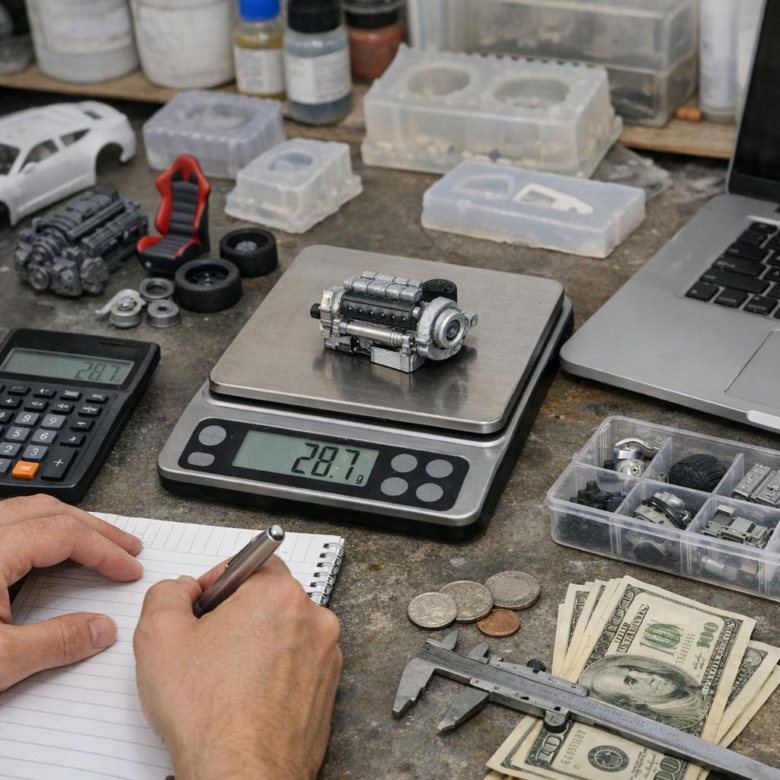
Start with a simple cost-per-part worksheet, not a guess. Track resin by grams or milliliters, silicone mold rubber by batch, pigments, release spray, pressure pot supplies, sanding materials, primer, packaging, payment processing fees, and replacement blades or mixing cups. A digital scale, a resin calculator, and a spreadsheet in Google Sheets are enough for most small sellers.
For example, if one 1:24 scale custom hood uses $1.40 in resin, $0.35 in pigment and cups, and $0.80 in finishing supplies, the material cost is $2.55 before labor. If the mold cost $32 to make and realistically produces 25 clean casts, add $1.28 per part for mold amortization. That small number matters when collectors order multiple pieces.
- Material cost: resin, silicone, colorants, release agent, consumables, failed-cast allowance.
- Labor cost: sculpting, mold prep, pouring, demolding, trimming, sanding, priming, packing.
- Finishing cost: wet sanding pads, automotive primer, clear coat, micro files, decals, polishing compounds.
Labor is where many resin casters underprice. Time every step with your phone for a few batches, then multiply by your target hourly rate; even 12 minutes of cleanup at $25 per hour adds $5 to the real production cost. In practice, tiny parts often take longer to finish than larger panels because air bubbles, flash lines, and fitment checks are less forgiving.
Add a waste buffer for miscasts, especially when using clear resin, complex vents, or two-part molds. A 10% to 20% allowance is reasonable for many hobby-scale runs, but adjust it based on your actual reject bin, not optimism.
Pricing Strategies That Balance Collector Demand, Rarity, and Profit Margin
Price custom resin cast car parts by combining production cost, collector demand, and scarcity-not just by adding a flat markup. Start with your true cost per unit: resin, silicone mold wear, pressure pot time, sanding supplies, primer, packaging, payment processing fees, and marketplace fees from platforms like Etsy or eBay.
A practical pricing method is to set a base price from cost, then apply a demand multiplier for rare or hard-to-find parts. For example, a 1:24 scale resin hood scoop that costs $6 to make might sell for $18-$22 if similar parts are available, but a discontinued rally car bumper conversion could justify $35-$50 if collectors have no easy alternative.
- Standard parts: price for steady sales and repeat buyers.
- Limited-run parts: charge more when mold life is short or casting is difficult.
- Commissioned parts: include design time, CAD work, test prints, and revisions.
Use sold listings on eBay, hobby forums, and Facebook collector groups to compare real buyer behavior, not just asking prices. In my experience, collectors will pay a premium for clean fitment, accurate scale detail, and safe shipping, but they push back fast when photos are vague or the part needs heavy cleanup.
Keep your profit margin healthy by pricing bundles carefully. A “three-part conversion kit” can increase average order value while lowering packaging cost per item, but only discount enough to protect your labor. Cheap pricing may win one sale; consistent quality builds a collector customer base.
The Bottom Line on How to Price Custom Resin Cast Car Parts for Online Collectors
Pricing custom resin cast car parts works best when it protects both your margin and your reputation. Treat every part as a small-batch collectible, not just a material cost plus markup. Set a price that covers labor, rejects, packaging, platform fees, and the skill behind the finish.
If demand is steady, raise prices gradually rather than racing to the bottom. If sales slow, improve photos, fitment notes, or bundle value before discounting. The right price is the one that collectors understand, you can defend, and your workshop can sustain.