Think a flawless racing livery is painted with a steady hand? It’s won or lost in the masking.
Complex liveries demand more than tape on panels-they require sequencing, surface reading, edge control, and a plan for every overlap, curve, vent, and compound contour.
Advanced masking is where sharp graphics, clean color breaks, sponsor-accurate shapes, and factory-level symmetry come together without bleed-through, ridges, or rework.
This guide breaks down the techniques professionals use to turn aggressive designs into crisp, durable paintwork worthy of the grid.
What Makes Racing Livery Masking Different: Curves, Layering, Symmetry, and Paint Order
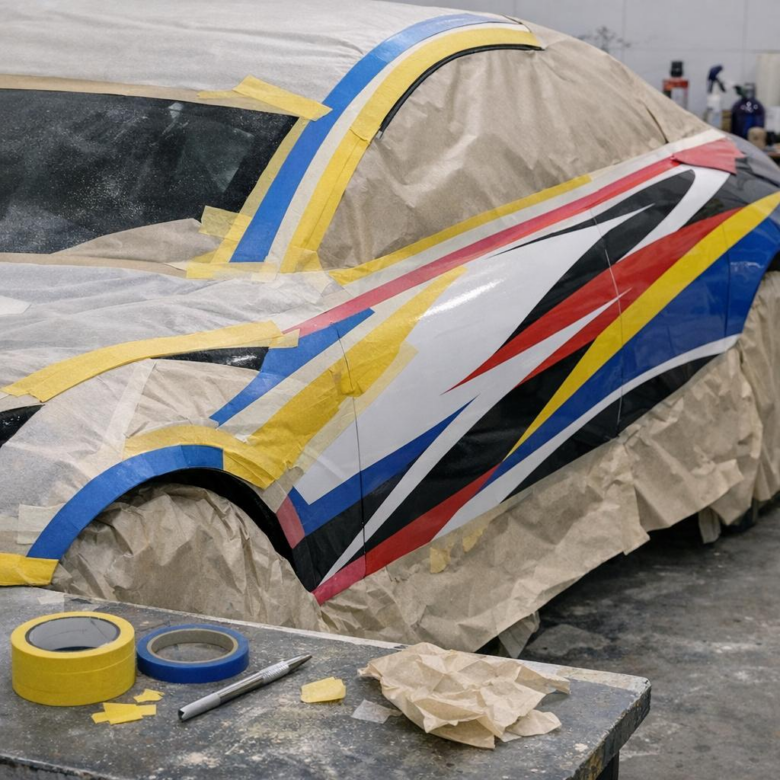
Racing livery masking is harder than standard model or automotive paint masking because the design has to look fast, balanced, and intentional from every angle. Long sweep curves, sponsor-style blocks, number panels, and pinstripes often cross panel gaps, vents, wheel arches, and body contours, so ordinary straight masking tape can quickly distort the design.
The biggest challenge is controlling curves without lifting edges or creating uneven paint lines. For tight arcs around fenders or nose cones, flexible products like 3M Fine Line Tape are far more reliable than standard masking tape because they stretch smoothly and resist paint bleed when sealed properly.
- Curves: Lay tape in short guided sections instead of forcing one long strip around complex bodywork.
- Layering: Plan which color sits underneath, especially when using white, fluorescent, metallic, or pearl automotive paint.
- Symmetry: Use paper templates, tracing film, or a vinyl plotter file to mirror graphics accurately from left to right.
Paint order matters more than many beginners expect. A real-world example is a red, white, and black GT-style livery: spraying white first usually gives cleaner number panels, then red graphics can be layered over it, with black accents added last to sharpen the design.
In a custom paint shop or serious hobby setup, digital tools such as Cricut Design Space or a vinyl cutter can reduce rework by producing repeatable masks for logos, stripes, and mirrored side graphics. The practical benefit is lower material cost, fewer sanding corrections, and a cleaner finish that looks planned rather than patched together.
How to Mask Complex Racing Graphics: Tape Selection, Stencil Placement, and Multi-Color Sequencing
Complex racing graphics need more than standard masking tape; they require the right combination of fine-line tape, transfer film, and low-tack stencil material. For sharp curves, use 3M or FBS fine-line tape in 1/8-inch or 1/4-inch widths, then back-mask with automotive masking paper to protect larger panels from overspray. On carbon fiber parts or fresh basecoat, always test adhesion first because aggressive tape can lift clear coat or leave adhesive residue.
Stencil placement should be treated like vinyl wrap installation: measure from fixed body lines, door gaps, hood vents, and wheel arches instead of guessing by eye. A vinyl cutter such as Graphtec Cutting Master paired with vector software lets you create repeatable number panels, sponsor logos, stripes, and layered decals for both sides of the car. In the shop, I’ve seen mirrored graphics fail simply because the installer measured from the front bumper on one side and the rear quarter on the other.
- Spray light colors first, then medium tones, then dark colors to reduce coverage problems.
- Remove stencil layers only after the paint flashes, not when it is fully cured.
- Use registration marks on transfer tape for multi-color racing livery alignment.
For a three-color GT-style livery, spray the white base first, mask the number box, apply red accent stripes, then finish with black shadow graphics or sponsor blocks. This sequencing reduces paint edge buildup and lowers the cost of rework, especially when using premium automotive paint systems, airbrush equipment, or professional spray booth services. Clean edges come from planning, not luck.
Pro-Level Masking Fixes: Preventing Bleed-Through, Edge Lift, Misalignment, and Paint Build-Up
Bleed-through usually comes from dirty panels, rushed tape placement, or spraying too wet near the edge. Before masking, wipe the surface with wax and grease remover, then a tack cloth, and burnish the tape edge with a plastic squeegee instead of your finger. On carbon panels or curved motorcycle fairings, I’ve seen even premium tape fail when polish residue was left in a body line.
For sharp racing stripes and sponsor graphics, use fine line tape such as 3M Scotch Fine Line Tape for the actual edge, then back-mask with automotive masking paper or film. Avoid cheap household painter’s tape; the adhesive is not designed for solvent-based automotive paint, clear coat, or booth heat. Good masking supplies cost more, but they reduce rework, sanding time, and paint correction labor.
- Edge lift: stretch tape lightly around curves, not tightly; over-stretched tape tries to return to its original shape.
- Misalignment: use centerline marks, laser levels, or measured reference points from fixed body features, not panel gaps alone.
- Paint build-up: spray away from the tape edge first, then finish with lighter coats instead of loading paint against the mask.
A practical shop trick is to “seal” complex tape edges with a light coat of the base color before spraying the next color. If anything creeps under the tape, it is the same color underneath, not the contrasting stripe. Remove tape when the paint is tacky but stable; waiting until it fully cures can create jagged edges or pull up fresh layers.
Summary of Recommendations
Complex racing liveries reward patience more than speed. The best results come from treating masking as a precision workflow, not a quick prep step: test your materials, plan the paint order, and remove each mask with control.
- Use flexible tapes for curves, sharp blades for edges, and low-tack films for delicate layers.
- Choose liquid mask only where tape cannot conform cleanly.
- Prioritize thin coats to reduce ridges, bleed, and rework.
When in doubt, simplify the masking sequence rather than forcing a risky layout. Clean execution will always outshine unnecessary complexity.