What if your open-concept home looks expensive by day-but feels disjointed the moment the lights come on?
In luxury interiors, lighting is not just illumination; it is spatial choreography. A single great room may need to flatter artwork, define a dining area, soften a lounge, and support late-night entertaining-all without visual clutter.
Multi-zone smart lighting makes that possible by layering fixtures, scenes, sensors, and controls into a system that responds to how the home is actually lived in. The goal is not more technology, but more atmosphere, precision, and ease.
This guide explores how to design elegant, intuitive lighting scenes for open-concept homes where every zone feels distinct, connected, and effortlessly refined.
What Defines a Multi-Zone Smart Lighting Scene in a Luxury Open-Concept Home?
A multi-zone smart lighting scene is a coordinated setup where different areas of an open-concept space have their own lighting behavior while still feeling visually connected. In a luxury home, this might mean the kitchen island uses bright task lighting, the dining area shifts to warm dimmed pendants, and the lounge glows with soft accent lighting-all triggered by one command or schedule.
The key difference is control by zone, not just by room. Open layouts often combine cooking, dining, entertaining, and relaxing in one large footprint, so a single lighting level usually feels either too harsh or too flat. Platforms like Lutron HomeWorks, Control4, and Philips Hue allow homeowners or lighting designers to program scenes based on function, time of day, daylight levels, and mood.
- Task zones: brighter illumination for kitchen prep, bar counters, or reading chairs.
- Ambient zones: dimmable recessed lighting or cove lighting for overall comfort.
- Accent zones: wall washers, art lights, and LED strip lighting to highlight architecture or décor.
In real projects, the best scenes are usually subtle. For example, a “Dinner Party” scene may lower kitchen downlights to 40%, warm the dining chandelier, turn on cabinet lighting, and leave pathway lights active for safety. That creates atmosphere without sacrificing usability.
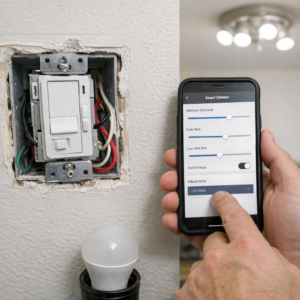
A well-defined multi-zone scene also considers smart dimmer compatibility, LED color temperature, fixture placement, energy efficiency, and integration with motorized shades or voice control. Done properly, it improves comfort, supports premium interior design, and helps justify the cost of a high-end smart lighting system.
How to Map Lighting Zones for Kitchens, Living Areas, Dining Spaces, and Transition Areas
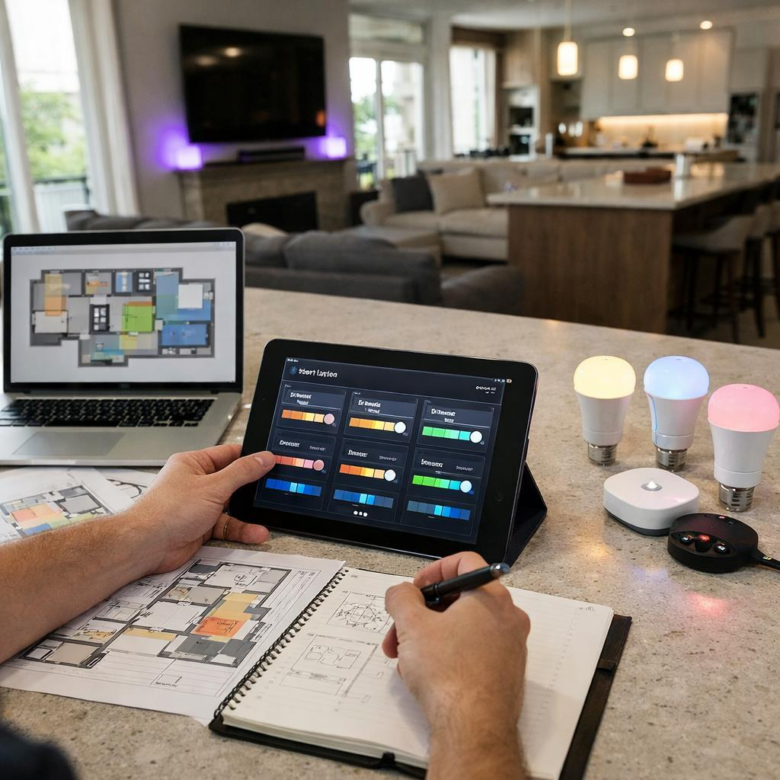
Start by mapping lighting zones around how people actually move, not just where fixtures are installed. In luxury open-concept homes, the kitchen, living area, dining space, and hallways often share sightlines, so each zone should feel independent while still blending smoothly through a smart lighting control system like Lutron HomeWorks, Control4, or Philips Hue.
For the kitchen, separate task lighting from ambient lighting. Under-cabinet LEDs, island pendants, recessed downlights, and toe-kick lighting should be assigned to different dimming zones so cooking, cleaning, and entertaining scenes can be adjusted without changing the whole room.
- Kitchen: task lighting, island lighting, cabinet lighting, and accent lighting.
- Living area: recessed lights, floor lamps, wall washers, and media lighting.
- Dining space: chandelier, perimeter lights, artwork lighting, and buffet lighting.
A real-world example: in one open-plan home, placing the dining chandelier on the same zone as kitchen downlights made dinner scenes feel too bright and clinical. Splitting them allowed a warm 40% dining scene while keeping the kitchen at 15% for background glow.
Transition areas need special attention because they connect the entire lighting design. Hallways, stair openings, and entry paths should use low-glare fixtures with motion sensors or scheduled scenes, especially for nighttime navigation and energy-efficient lighting automation.
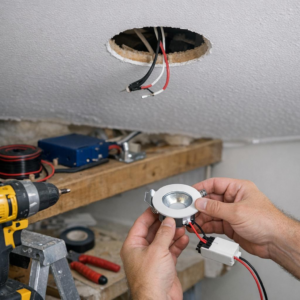
Before installation, label every circuit on a floor plan and review it with your electrician or lighting designer. This reduces smart lighting installation cost overruns and makes future upgrades, dimmer programming, and voice control integration much easier.
Common Multi-Zone Lighting Mistakes That Disrupt Ambience, Flow, and Control
One of the biggest mistakes in luxury smart lighting design is treating every zone as a separate island. In an open-concept kitchen, dining, and living area, the scenes must transition smoothly, not compete. If the kitchen pendants are warm and dim while the adjacent living room recessed lights are cool and bright, the whole space feels unfinished.
Another common issue is overloading the system with too many scenes. “Dinner,” “Relax,” “Movie,” “Entertain,” and “Evening” may sound useful, but if they are barely different, homeowners stop using them. A better approach is to build fewer, better-tuned scenes through platforms like Lutron HomeWorks, Control4, or Philips Hue, then assign them to keypads or voice control for simple daily use.
- Ignoring task lighting: Beautiful ambience fails if the countertop, bar, or reading chair is underlit.
- Mixing color temperatures: Random 2700K, 3000K, and 4000K fixtures can make premium interiors look inconsistent.
- Poor dimmer compatibility: Cheap LED bulbs on the wrong smart dimmer can flicker, buzz, or fail to dim smoothly.
In real installations, I often see homeowners spend heavily on designer fixtures but skip professional lighting control programming. That is where the experience breaks down. Before finalizing the smart home automation cost, test each scene at night, not just during installation, because glare, reflections, and shadow lines are far easier to spot in real conditions.
Key Takeaways & Next Steps
In a luxury open-concept home, the best lighting plan is not the most complex one-it is the one that makes every zone feel intentional without exposing the technology behind it. Treat scenes as lifestyle tools, not decorative presets: dining should flatter, circulation should guide, entertaining should adapt, and quiet areas should soften on command.
- Choose control systems that scale cleanly across zones and integrate with shades, climate, and security.
- Prioritize commissioning so dimming curves, color temperature, and keypad logic feel natural from day one.