Your paint job isn’t failing because of the airbrush-it’s failing because the compressor can’t keep up.
At 1/24 scale, every mist coat, panel fade, clear layer, and tire-sidewall detail depends on stable airflow, clean pressure, and precise control. A pulsing, noisy, or moisture-prone compressor can turn carefully prepped plastic into orange peel, spatter, or uneven coverage.
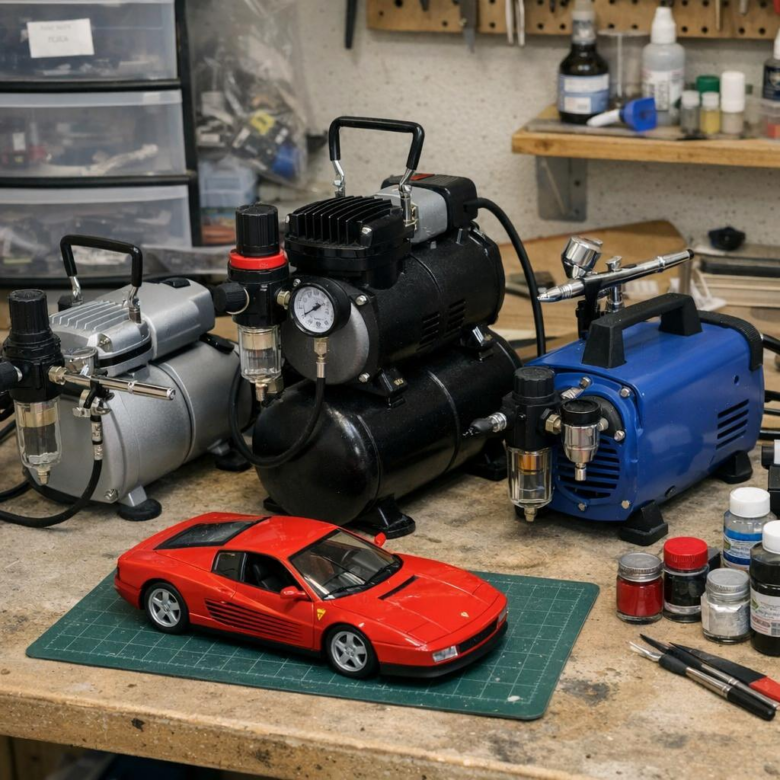
The best airbrush compressors for detailing automotive kits are not always the biggest or most expensive. What matters is consistent PSI, a reliable regulator, moisture control, low vibration, and enough reserve air to spray lacquer, acrylic, primer, and clear without fighting the equipment.
This guide focuses on compressors that actually make sense for model car builders-especially those working on bodies, interiors, engines, trim, weathering, and fine-scale finishes where control matters more than brute power.
What Defines the Best Airbrush Compressor for 1/24 Scale Automotive Detailing?
The best airbrush compressor for 1/24 scale automotive detailing is not simply the most powerful model; it is the one that gives stable, controllable airflow for small parts, gloss finishes, and fine trim work. For plastic model cars, a compressor with an air tank, moisture trap, pressure regulator, and low noise output is usually worth the extra cost because it prevents pulsing, water spits, and uneven clear coat application.
For most 1/24 scale kits, you will spend a lot of time spraying between 12 and 25 PSI, depending on the paint system and nozzle size. Lacquers such as Mr. Color or Tamiya LP often atomize well at moderate pressure, while primers and clear coats may need slightly more airflow to lay down smoothly without orange peel.
- Consistent PSI: Helps with fine panel lines, interiors, engine bays, and two-tone paint masking.
- Air tank capacity: Reduces motor cycling and gives smoother spray control during body shell painting.
- Moisture control: A proper water trap is essential if you paint in a humid garage, basement, or spare room.
A real-world example: when spraying a 1/24 touring car body with metallic silver, a tankless budget compressor can create tiny pressure pulses that show up as uneven flake distribution. A compact tank compressor such as the Iwata Smart Jet Pro or similar hobby airbrush compressor makes it easier to maintain a wet edge and avoid patchy panels.
Look for a quiet airbrush compressor around 47-60 dB if you paint indoors, especially in apartments or shared spaces. The best choice balances performance, maintenance, replacement parts, and long-term reliability rather than chasing the cheapest airbrush kit bundle.
How to Match PSI, Airflow, and Tank Size to Fine-Detail Model Car Painting
For 1/24 scale automotive kits, the goal is not raw power; it is stable, controllable air. Most fine-detail airbrushing works best around 12-20 PSI, especially for panel shading, interior parts, trim, and low-volume color coats. A quality regulator with a moisture trap is more important than chasing a high maximum PSI rating.
Airflow matters because it determines whether your airbrush can keep a consistent spray pattern without pulsing. For gravity-feed airbrushes like an Iwata Eclipse HP-CS or similar 0.3-0.35 mm setup, look for a compressor that can supply steady low-pressure airflow rather than a noisy hobby compressor that struggles after a few seconds of spraying.
- 10-15 PSI: fine lines, shading, weathering, and thin lacquer or acrylic paint
- 15-20 PSI: primer touch-ups, body color, and small clear-coat sections
- 20-25 PSI: thicker primer or larger body shells, only if the paint is properly thinned
Tank size affects consistency. A 1-3 liter tank is usually enough for model car detailing because it smooths airflow, reduces compressor cycling, and helps prevent pressure drops during long passes across a hood or door panel. Tankless units can work, but they often pulse slightly, which shows up as uneven metallic flakes or patchy clear coat.
A real-world example: spraying a 1/24 Skyline body with thinned lacquer at 18 PSI is much easier with a small tank compressor and dual-action airbrush than with a basic nail-art unit. You get smoother coverage, less overspray, and better control around vents, mirrors, and window trim-exactly where cheap air compressor kits usually reveal their limits.
Common Airbrush Compressor Mistakes That Ruin 1/24 Scale Automotive Finishes
One of the biggest mistakes is spraying straight from a small airbrush compressor without checking pressure stability. For 1/24 scale car bodies, even a slight PSI surge can turn a smooth lacquer coat into orange peel or dry spray, especially around door lines, bumpers, and wheel arches.
Using the wrong pressure is just as damaging. Many modelers spray automotive primers at 25-30 PSI because the compressor can do it, but fine detailing usually looks cleaner around 12-18 PSI with properly thinned paint. A regulator and moisture trap, such as those on a Sparmax or Iwata Smart Jet setup, are not optional if you want consistent gloss and clean metallic flakes.
- Skipping the moisture trap: Water in the airline can spit onto clear coat and leave tiny craters that are hard to polish out.
- Ignoring duty cycle: Cheap tankless compressors can overheat during a full body color session, causing pressure drop and rough texture.
- Using too short an air hose: Heat and pulsing reach the airbrush faster, which can affect paint flow on longer spray passes.
A real-world example: when spraying a 1/24 Tamiya Nissan GT-R body with metallic silver, a tankless compressor may look fine on a spoon test but pulse noticeably across the roof panel. A small airbrush compressor with a tank, pressure gauge, moisture filter, and adjustable regulator costs more upfront, but it reduces sanding, repainting, and wasted premium hobby paint.
Closing Recommendations
The right compressor should make detailing feel controlled, not compromised. For 1/24 automotive kits, prioritize steady low-pressure performance, a moisture trap, and quiet operation over raw power.
- Choose a tank-equipped compressor if you want smoother airflow for gloss coats and fine shading.
- Pick a compact quiet model if you paint occasionally or work in a shared space.
- Avoid bargain units that pulse, overheat, or lack pressure control.
Your best choice is the compressor that lets you spray consistently at low PSI, so panel lines, interiors, trim, and clear coats come out clean and repeatable.