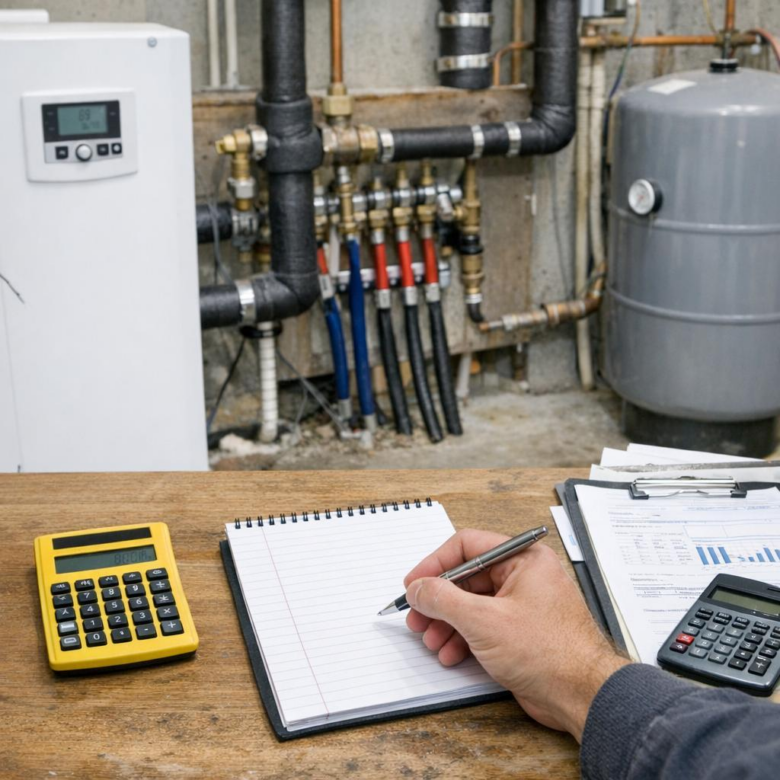
What if your “expensive” geothermal system is actually one of the safest long-term investments in your home?
Residential geothermal heat pumps can slash heating and cooling costs, reduce maintenance, and add durability-but the upfront price makes ROI harder to judge than a simple payback guess.
To calculate the real return, you need to compare installation cost, tax credits, energy savings, financing, maintenance, system lifespan, and local utility rates.
This guide breaks down the numbers so you can estimate when geothermal pays for itself-and whether it makes financial sense for your specific home.
Residential Geothermal Heat Pump ROI Basics: Upfront Costs, Energy Savings, and Payback Period
Residential geothermal heat pump ROI starts with three numbers: total installed cost, annual energy savings, and the expected payback period. Installed costs usually depend on loop type, drilling conditions, home size, ductwork upgrades, and whether you are replacing an old furnace, central air conditioner, or both.
A practical ROI estimate should include more than the geothermal heat pump unit price. Ask contractors to separate costs for ground loop installation, indoor equipment, electrical work, permits, thermostat controls, and any duct sealing or insulation improvements that affect heating and cooling efficiency.
- Upfront cost: equipment, excavation or drilling, labor, permits, and system design.
- Energy savings: reduced electricity, propane, heating oil, or natural gas use compared with your current HVAC system.
- Payback period: net project cost divided by estimated annual utility savings.
For example, if a homeowner replaces an aging oil furnace and central AC with a geothermal system, the savings may be stronger than a home already using a high-efficiency air-source heat pump. In the field, the biggest surprises often come from loop installation costs and undersized ductwork, so a detailed Manual J load calculation is worth requesting before signing a contract.
Use recent utility bills and a calculator such as ENERGY STAR Home Energy Yardstick to establish your current energy baseline. Then compare contractor proposals after federal tax credits, local rebates, financing costs, and expected maintenance savings, because geothermal ROI is rarely accurate when judged by equipment cost alone.
How to Calculate Geothermal Heat Pump ROI Using Utility Bills, Tax Credits, and Maintenance Savings
Start with your actual utility bills, not a generic online estimate. Pull 12 months of electric, gas, propane, or heating oil costs from your utility portal or a tool like ENERGY STAR Home Energy Yardstick, then separate heating and cooling costs as closely as possible.
The basic ROI formula is simple: divide your net geothermal installation cost by your annual savings. Net cost means the full geothermal heat pump system price minus federal tax credits, state rebates, utility incentives, and any HVAC financing discounts.
- Annual energy savings: old heating and cooling costs minus projected geothermal electricity cost
- Tax credit value: apply eligible federal geothermal tax credits to reduce upfront cost
- Maintenance savings: compare current furnace, boiler, AC, fuel delivery, and service plan costs
For example, if a homeowner spends $3,200 per year on propane heating and central air conditioning, and a contractor estimates geothermal operating costs at $1,450 per year, the energy savings are $1,750 annually. If the installed system costs $34,000 and tax credits plus local rebates reduce it to $23,800, the simple payback is about 13.6 years before maintenance savings.
Maintenance can quietly improve the numbers. In real projects, I’ve seen older homes with aging oil furnaces save more because they avoid burner service, chimney issues, fuel tank concerns, and separate AC repairs.
For a cleaner estimate, ask your geothermal contractor for a Manual J load calculation and projected kilowatt-hour usage, then compare it against your utility rate. This gives you a more reliable geothermal ROI calculation than using national averages, especially in areas with high propane, oil, or electricity prices.
Common Geothermal ROI Mistakes to Avoid and Strategies to Maximize Long-Term Returns
One of the biggest geothermal ROI mistakes is calculating payback using only the equipment price. A residential geothermal heat pump installation also includes ground loop design, drilling or trenching, ductwork upgrades, electrical work, permits, and sometimes a new thermostat or zoning system. If these are missing from your geothermal cost estimate, your ROI calculation will look better than reality.
Another common error is using average utility rates instead of your actual energy bills. Before committing, compare at least 12 months of electric, propane, oil, or natural gas costs, then model savings with a tool like ENERGY STAR’s Home Energy Yardstick or contractor-provided load calculation software. In real projects, homes with high heating oil bills often see stronger returns than homes already using low-cost natural gas.
- Get a Manual J load calculation: Oversized systems cost more upfront and may reduce efficiency.
- Verify incentives early: Federal tax credits, state rebates, and utility geothermal incentives can materially change ROI.
- Plan maintenance costs: Include filter changes, circulating pump checks, and periodic professional service.
To maximize long-term returns, focus on the building envelope before sizing the system. Air sealing, attic insulation, and duct sealing can lower the required geothermal system capacity, reducing installation cost while improving comfort. A smaller, properly designed system usually beats a bigger system sold as “extra protection.”
Finally, compare contractor proposals by total lifecycle value, not just price. Ask for estimated annual kWh usage, warranty terms, loop field specifications, and expected maintenance requirements. The cheapest bid can become expensive if the loop is undersized or the heat pump efficiency rating is lower than promised.
Closing Recommendations
The real value of a residential geothermal heat pump is measured over time, not at installation. A higher upfront cost can make sense when long equipment life, stable energy savings, incentives, and increased home comfort align with your budget and property conditions.
- Choose geothermal if your payback period fits your ownership timeline.
- Prioritize accurate local energy rates, installer quotes, and available tax credits.
- Avoid relying on averages-site conditions can significantly change ROI.
If the numbers show durable savings and you plan to stay in the home, geothermal can be a financially sound long-term investment.