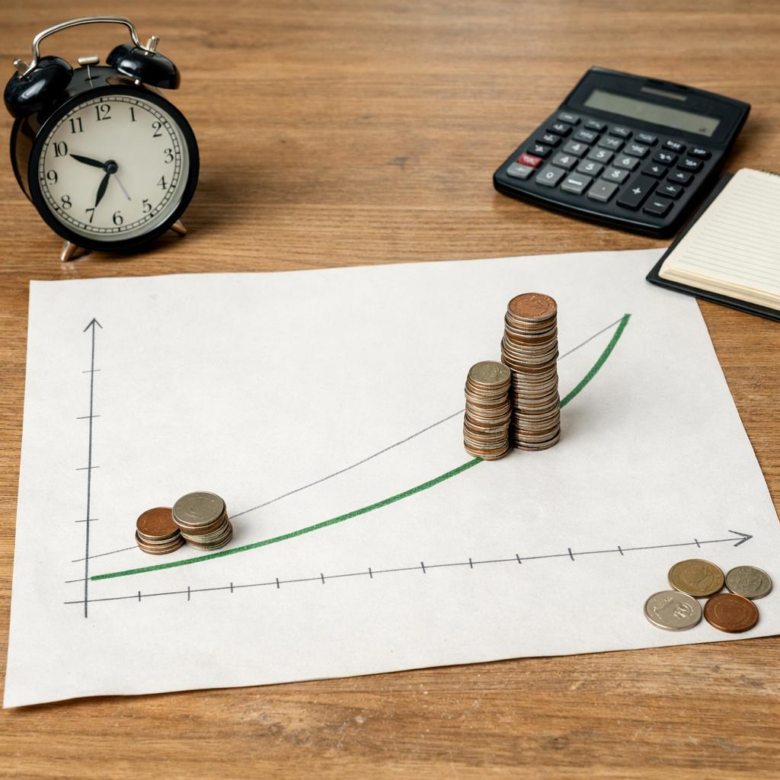
What if your money could earn money-then that money could earn even more?
That is the power of compound interest, a simple financial force that can turn small, consistent amounts into meaningful wealth over time.
Unlike simple interest, which grows only on your original amount, compound interest builds on both your principal and the interest already earned. The longer it has to work, the more dramatic the results can become.
Understanding how compound interest works can help you save smarter, invest earlier, and avoid costly debt that compounds against you.
What Is Compound Interest and Why Time Is Its Biggest Advantage?
Compound interest is the process of earning interest not only on your original money, but also on the interest that money has already earned. In simple terms, your savings or investment balance starts to grow on top of itself. This is why compound interest is often more powerful in a retirement account, high-yield savings account, brokerage account, or long-term investment plan than in short-term saving.
Time is the biggest advantage because compounding needs repeated cycles to become meaningful. For example, if someone invests $200 per month in a low-cost index fund through a platform like Vanguard, the early years may feel slow. But after years of reinvested returns, a larger share of the growth can come from previous gains rather than new deposits.
A useful way to think about compound interest is that three factors do most of the work:
- Principal: the amount you start with or add regularly.
- Rate of return: the interest rate or investment return you earn.
- Time: how long your money stays invested and continues compounding.
In real life, I’ve seen people focus too much on finding the “perfect” investment and delay starting. That delay can be costly because even a modest investment calculator will show how early contributions can outweigh larger deposits made later. Using tools like a compound interest calculator, automated investing app, or employer 401(k) plan can help you see the cost of waiting and make consistent contributions easier.
How to Calculate Compound Interest for Savings, Investments, and Debt
To calculate compound interest, use this formula: A = P(1 + r/n)^(nt). In plain English, “P” is your starting balance, “r” is the annual interest rate, “n” is how often interest compounds per year, and “t” is the number of years.
For example, if you deposit $5,000 into a high-yield savings account with a 4.5% annual percentage yield and leave it for 5 years, your balance grows because each interest payment starts earning interest too. You can run this quickly with a compound interest calculator on Investor.gov, or use a spreadsheet in Google Sheets or Excel for comparing different savings accounts, investment returns, or loan costs.
- Savings: Use the interest rate or APY from your bank and check whether interest compounds daily or monthly.
- Investments: Use an estimated annual return, but remember that stock market returns are not guaranteed.
- Debt: Use the loan APR or credit card interest rate to see how fast unpaid balances can grow.
One practical insight: compounding helps you when you earn interest, but it works against you when you carry expensive debt. A credit card balance with a high APR can grow much faster than most bank savings rates, which is why paying down high-interest debt often delivers a stronger financial benefit than chasing a slightly better savings yield.
When comparing financial products, look beyond the advertised rate. Fees, minimum balances, compounding frequency, loan terms, and early withdrawal penalties can all change the real cost or benefit over time.
Common Compound Interest Mistakes That Reduce Long-Term Growth
One of the biggest mistakes is waiting too long to start, even when the amount is small. A person who invests $100 per month in a retirement account at age 25 usually has a major advantage over someone who starts later with larger deposits, because time does more of the heavy lifting. That is why delaying contributions to a 401(k), IRA, or brokerage account can quietly reduce future growth.
Another common problem is interrupting compounding by withdrawing money too often. For example, using an investment account as an emergency fund may feel convenient, but selling assets early can trigger taxes, fees, and lost future gains. A better setup is keeping short-term cash in a high-yield savings account while leaving long-term investments untouched.
- Ignoring fees: High expense ratios, advisory fees, and account charges can reduce returns year after year.
- Carrying high-interest debt: Credit card interest can compound against you faster than many investments grow.
- Not reinvesting dividends: Taking payouts as cash instead of reinvesting them can slow portfolio growth.
It also helps to use realistic planning tools instead of guessing. Platforms like Vanguard, Fidelity, or a compound interest calculator can show how contribution amount, rate of return, fees, and investment timeline affect the final balance. In real financial planning, I often see people focus only on the expected return while overlooking costs and consistency, which are usually easier to control.
The practical fix is simple: automate contributions, keep fees low, pay down expensive debt, and give your money enough time to work. Small habits matter. Over decades, they can make the difference between average savings and meaningful long-term wealth.
The Bottom Line on How Compound Interest Works and Why It Matters Over Time
Compound interest rewards time, consistency, and patience. The most important decision is not waiting for the perfect moment, but starting with what you can and letting time do more of the work.
Use compound interest deliberately: invest regularly, reinvest earnings, keep costs low, and avoid interrupting growth unless necessary. Small choices made early can create meaningful differences later, while delays often require much larger contributions to catch up.
The practical takeaway is simple: treat compounding as a long-term habit, not a quick result. The sooner your money begins working, the more powerful each future decision becomes.