What if your “58°C” sous vide bath is quietly cooking at 56.8°C?
In a commercial kitchen, that small error can mean uneven texture, failed HACCP records, longer service times, or food that never reaches the consistency your menu promises.
Calibrating commercial sous vide equipment is not just a maintenance task-it is the foundation of precision cooking, repeatable results, and defensible food safety.
This guide explains how to verify, adjust, and document sous vide temperature accuracy so every pouch performs exactly as intended.
What Calibration Means for Commercial Sous Vide Precision, Food Safety, and Batch Consistency
Calibration means verifying that your commercial sous vide circulator, water bath, or temperature probe is reading the true water temperature-not just the number shown on the display. In a restaurant kitchen, even a small temperature drift can affect cooking precision, HACCP food safety compliance, product yield, and customer consistency.
For example, if a circulator is set to 54°C for medium-rare beef but the actual bath temperature is 52.5°C, the steak may not reach the intended pasteurization target within the planned cook time. That creates a food safety risk, especially in high-volume batch cooking where dozens of vacuum-sealed portions are served from the same water bath.
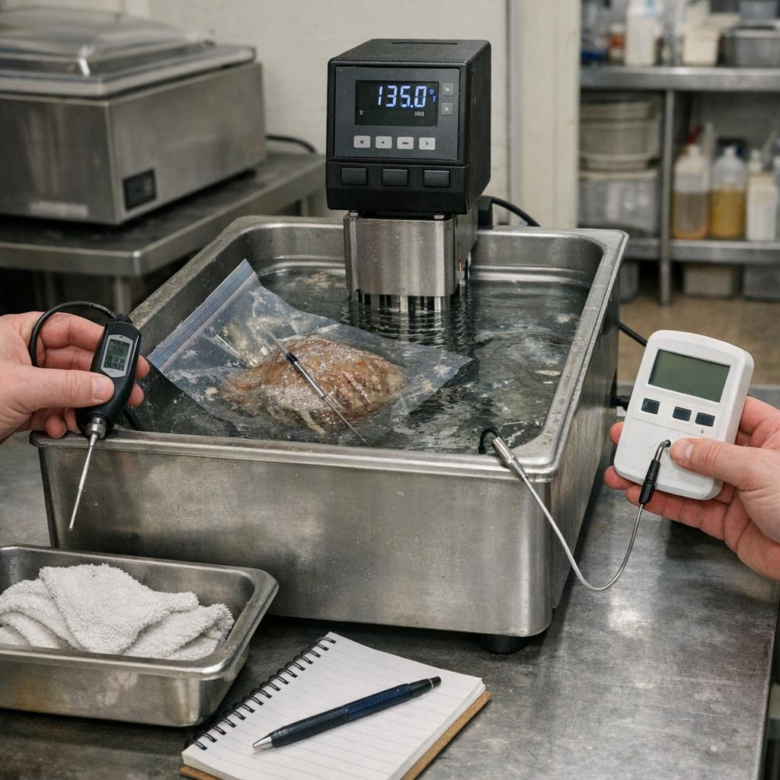
In practice, calibration usually involves comparing the sous vide unit against a certified reference thermometer, such as a ThermoWorks Reference Thermapen or a calibrated digital probe with a traceable certificate. Many commercial kitchens also log these readings for health inspections, insurance documentation, and internal quality control.
- Precision: Keeps proteins, sauces, eggs, and prepared meals within the exact temperature range required for repeatable texture.
- Food safety: Supports proper time-temperature controls for sous vide pasteurization and reduced oxygen packaging procedures.
- Batch consistency: Reduces variation between lunch prep, dinner service, catering orders, and multi-location restaurant operations.
A useful real-world habit is checking calibration before large production runs, not after complaints appear. In my experience, kitchens that treat calibration as routine equipment maintenance spend less time troubleshooting overcooked chicken, uneven steaks, or failed temperature logs-and more time producing consistent, profitable plates.
How to Calibrate Commercial Sous Vide Equipment Using Reference Thermometers and Controlled Water Baths
Start with a calibrated reference thermometer, not a kitchen probe that has been dropped in a drawer for months. In commercial kitchens, I prefer using a NIST-traceable digital thermometer such as ThermoWorks Reference Thermapen or a high-accuracy data logger, because health inspections, HACCP records, and food safety audits often require defensible temperature documentation.
Fill a deep, clean container with water and allow the sous vide circulator to run for at least 20-30 minutes at a common working temperature, such as 55°C for proteins or 85°C for vegetables. Place the reference probe near the center of the bath, away from the heater outlet and container walls, then compare its reading against the circulator display after the water stabilizes.
- If the circulator reads 63.0°C and the reference thermometer reads 62.4°C, record a -0.6°C offset.
- Repeat the test at two or three set points, such as 55°C, 65°C, and 85°C.
- Check multiple locations in the bath to confirm circulation consistency.
For example, a restaurant using sous vide for chicken service may discover that one commercial immersion circulator runs 0.7°C low at 65°C. That small difference matters when cooking vacuum-sealed poultry in bulk, especially where pasteurization time and temperature control affect both safety and texture.
If your unit allows adjustment, enter the correction offset through the equipment settings; otherwise, label the machine with the verified offset and update your prep sheets. Keep a calibration log with date, technician, device serial number, reference thermometer ID, and corrective action, since this is often more valuable than the adjustment itself during insurance reviews or food safety compliance checks.
Common Sous Vide Calibration Errors That Cause Temperature Drift, Uneven Cooking, and Compliance Risks
One of the most common mistakes is calibrating the circulator against a low-quality kitchen thermometer instead of a certified reference thermometer. In commercial kitchens, a small temperature error can affect pasteurization, HACCP records, and product consistency, especially with poultry, eggs, seafood, or long-hold proteins.
Another issue is checking temperature only near the immersion circulator. The bath may read correctly at the pump outlet but drift several tenths of a degree in the corners, particularly in large tanks or crowded racks. I’ve seen this happen during prep for banquet service: short ribs near the edge of the bath cooked slower because vacuum bags blocked water circulation.
- Using an uncalibrated probe: Verify readings with a traceable digital thermometer such as a ThermoWorks Reference Thermapen or a NIST-traceable probe.
- Skipping multi-point checks: Test the center, corners, and near the heating element, not just one location.
- Ignoring load conditions: Calibrate with water volume, racks, and bag density similar to real production.
Staff also cause drift by topping up the bath with cold water without allowing recovery time. If your sous vide equipment is connected to food safety compliance software or digital temperature logging systems, that dip may create a record that looks like a critical control failure.
For best results, document calibration date, reference device serial number, correction factor, and corrective action. This protects food quality, reduces equipment service costs, and gives inspectors a clear trail during commercial kitchen audits.
Closing Recommendations
Precision cooking depends on treating calibration as a routine control, not a one-time setup. The practical standard is simple: verify temperatures with a trusted reference, document the results, and act immediately when readings drift beyond tolerance.
- Calibrate regularly based on usage, menu risk, and manufacturer guidance.
- Keep records to support consistency, food safety, and staff accountability.
- Service or replace equipment when adjustments no longer hold stable results.
For any commercial kitchen, the right decision is the one that protects both product quality and customer safety every service.